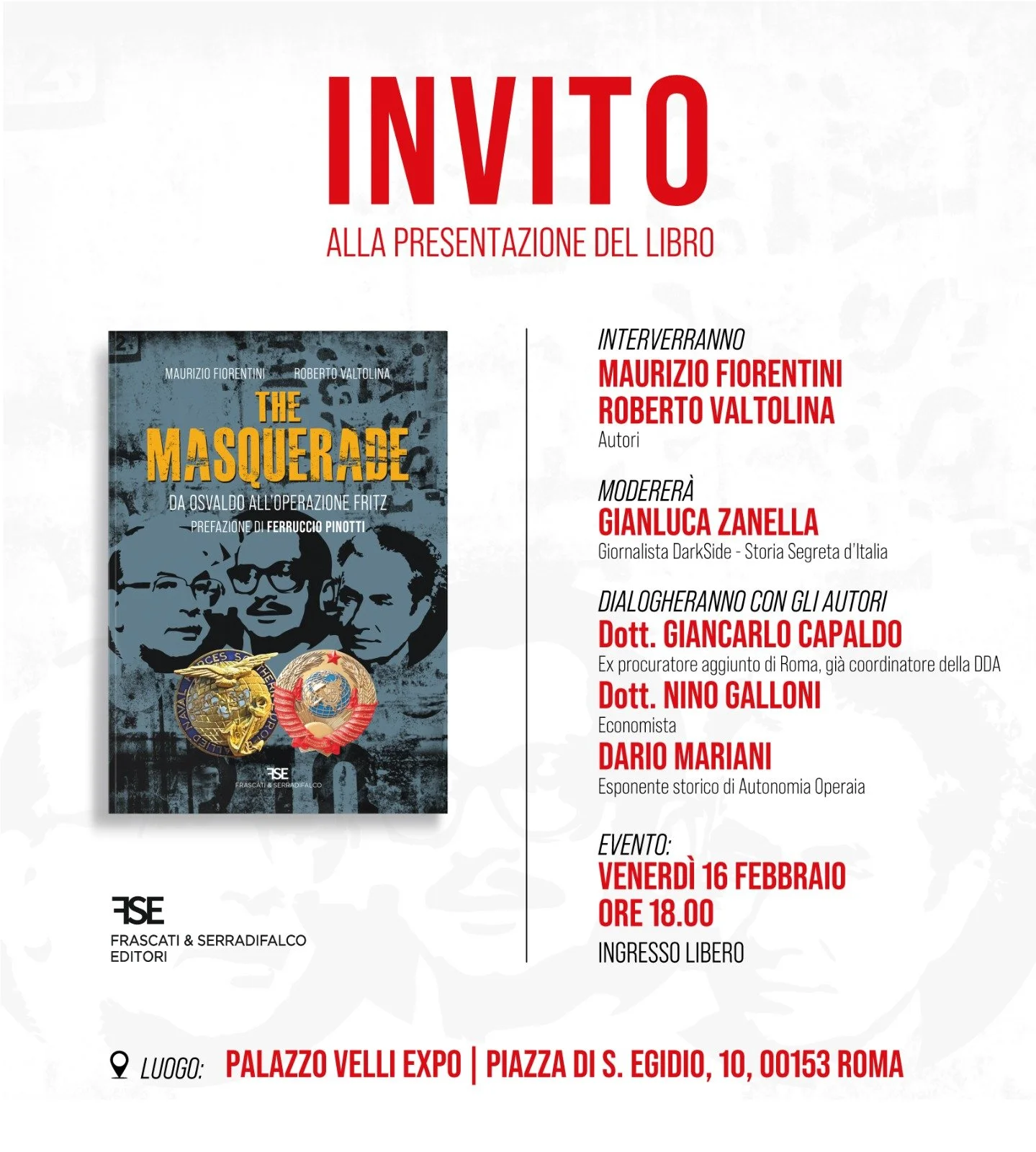
the book
The Masquerade offers a comprehensive reconstruction of the 1970–1980 decade—the darkest and bloodiest period Italy experienced during the Cold War. It is the product of a unique collaboration between Maurizio Fiorentini, a leader of a Roman Autonomia Operaia collective, and investigative writer Roberto Valtolina.
A rarity in the realm of non-fiction, the book unfolds in reverse chronological order, tracing the path from the aftermath of the Moro affair back to the early gestation of "Red terrorism." It examines events and figures one by one: investigators, suspects, state apparatuses, magistrates, politicians, militants, movements, victims, and spies. It avoids shortcuts, logical leaps, easy concessions, and conspiracy theories. Instead, it presents a compelling narrative driven by facts, set against the backdrop of the clash between Cold War blocs—a "dirty war" that did not end on November 9, 1989, but continues to this day.
Craxi, Feltrinelli, Moro. The first—through two explosive letters sent to Italy’s top state officials before fleeing to Tunisia—exposed the raw nerve of the relationships between the Eastern Bloc, a faction of the Italian Left, and terrorism. The second—an eccentric billionaire publisher—forged an ideological chain that led the Red Brigades (BR) to carry out "Operation Fritz." The third—a victim of the geopolitical balance established at Yalta and the policy of "firmness"—was kidnapped by the BR. His captors kept a foreign navy badge in their hideout on Via Gradoli. This is the most sensational new detail revealed by The Masquerade—a fact inexplicably overlooked by the intelligence chiefs of the time, Interpol, the Rome Police Headquarters, five trials, two Moro Commissions, and even the three parliamentary commissions on Terrorism, the P2 lodge, and the Mitrokhin Archive. Many key figures from that era—some of whom stayed in the Via Gradoli apartment—are still alive, and it is time for them to speak out: if not before magistrates, then at least to the public.
Send feedback